Insights / Security Careers
Why Great Cops Struggle in Corporate Jobs, and the Formula That Fixes It
By Warren Pulley ·
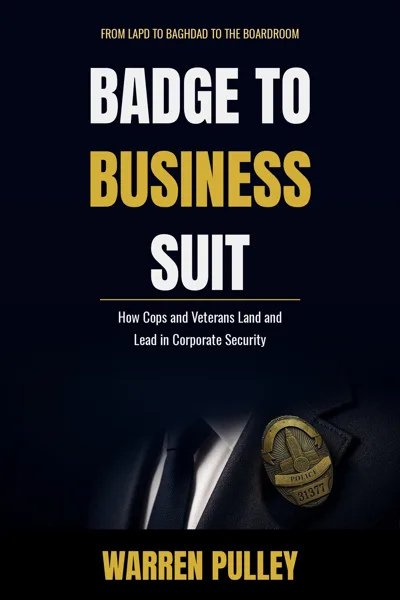
The main lesson of Badge to Business Suit is simple: great cops struggle in corporate jobs because they describe their value in terms of what they did, while a business hires for what you can do for its bottom line, its people, and its reputation. Fix that one gap and most other problems get smaller.
Why does the gap exist?
Police work is organized around incidents: a call comes out, you handle it, write it up, and clear. A corporation is organized around outcomes: revenue, cost, risk, and reputation. To a business, an incident is a failure that already happened. When a former officer talks only about the calls he handled, he is describing how good he was at responding to failure, while the interviewer wants to know whether he can prevent it.
Veterans face a related trap. The military teaches missions, orders, and chains of command. In a company, authority is often informal. You may be responsible for a building where you supervise no one, and you have to persuade facilities, HR, legal, and operations. Orders do not work there. Influence does.
Five ways the gap shows up
- Speaking in jargon. Codes and acronyms are a wall to a hiring manager outside law enforcement.
- Telling war stories instead of business cases. A dramatic story without a business point sounds like someone who misses the action.
- Assuming authority you no longer have. In a company, people listen because you are useful and credible, not because of a badge.
- Underselling the paperwork. Writing a factual record that holds up months later is exactly what legal and HR need from security.
- Ignoring the money. Security is a cost center. Leaders who rise learn to talk about what a program costs, saves, and reduces.
What is the translation formula?
Chapter 3 gives a formula for every résumé line, LinkedIn entry, and interview answer: verb + what you did + for whom or what + scale or result. Each line should answer three questions: what was the problem or responsibility, what did you do, and what was the result or scope in people, property, money, time, or risk.
The book's rule on numbers is strict: use a real, verifiable number if you have one; if you do not, use scope, such as the size of the area or the number of people you supervised. Never make up a number. A hiring manager who catches one invented figure will discount everything else.
A simple example from the book's jargon list: "Entry control point" becomes "Managed access to a secured facility, screening people, vehicles, and credentials."
What else is inside?
The book covers choosing a lane in corporate security, building an ATS-friendly résumé, winning behavioral interviews, and leading as a civilian, with worksheets, a translation glossary, and a 40-question interview bank. If you are interested in protective work specifically, see The Protective Detail. If you are starting out in private security, see Guard Card Hawaii.
Get Badge to Business Suit
Paperback on Amazon Kindle on Amazon See the book page
As an Amazon Associate I earn from qualifying purchases.
Working on a threat concern now? Get the free Threat Assessment First-Response Checklist.