Insights / Workplace
California’s Workplace Violence Prevention Plan: What SB 553 Requires, and What It Doesn’t
By Warren Pulley ·
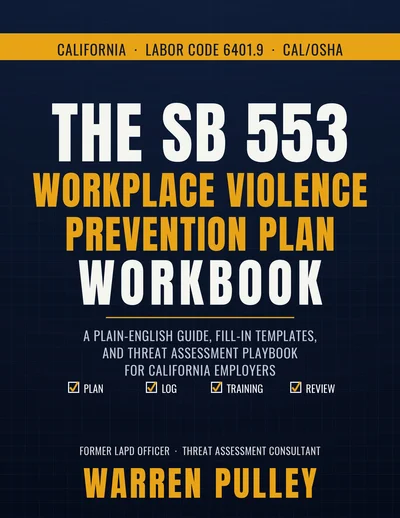
The most important word in California’s workplace violence law is effective. The SB 553 Workplace Violence Prevention Plan Workbook starts from that point: a plan that sits in a binder no one has opened does not meet the standard. Since July 1, 2024, Labor Code section 6401.9 has required nearly every California employer to establish, implement, and maintain an effective written plan. Cal/OSHA has been citing employers whose plans exist only on paper.
What does SB 553 actually require?
If you strip away the subparagraphs, the workbook says the law asks five things of an employer:
- A written plan. It must be in effect at all times and in all work areas, easy for employees to get to, and specific to the hazards of each work area and operation. It can stand alone or be a section of your Injury and Illness Prevention Program (IIPP).
- A violent incident log. Every workplace violence incident is recorded, with the fields the statute lists, and with personal identifying information removed.
- Training. When the plan starts, every year after that, and again when a new hazard is found or the plan changes. The material has to fit the workforce’s education level, literacy, and language.
- Records. Hazard, log, and investigation records are kept for five years and training records for one. Employees can ask to see most of them, and the employer has 15 calendar days to provide them at no cost.
- Ongoing review. At least once a year, whenever a deficiency becomes apparent, and after every incident, with employees involved.
The plan itself has thirteen required elements, (A) through (M). They run from naming responsible people and involving employees to reporting without retaliation, emergency response, hazard identification and correction, post-incident response, and plan review.
What is the test of an "effective" plan?
The book offers one question an inspector’s reading of your plan should be able to answer: If an employee reports a threat at 2:00 a.m. on a Saturday, what happens next? If the plan can’t say who takes the report, who decides, and what they do, it describes good intentions, not procedures.
Employees are part of the test too. Inspectors interview them. An employee who doesn’t know the plan exists, or how to report a threat, is evidence that the plan isn’t implemented.
What does the law not require?
Employers often over-buy, so the workbook is just as clear about what the statute does not require:
- Security guards, metal detectors, cameras, or panic buttons. It requires timely correction of the hazards you find, and the fix is often a procedure, a staffing change, a lock, or better lighting.
- An anonymous hotline, although an anonymous option is a good idea.
- Cal/OSHA’s model plan. You can write your own, and using the model doesn’t guarantee compliance.
- Active-shooter drills by name, or a threat assessment team. The book argues that a small, trained team is still the most practical way to meet several elements at once.
Where does threat assessment fit?
SB 553 never uses the words "threat assessment." But it requires a front door for reports, protection for the people who report, a process to evaluate hazards, including employees who have shown threatening behavior, and a record of what was done. That is the skeleton of a behavioral threat assessment and management program. Chapter 15 of the workbook adds the rest: a core team of three to five people, what behaviors to report, and the central question of whether a person poses a threat, not only whether they made one. For more on that distinction, see Making a Threat vs. Posing a Threat.
What is still changing?
Cal/OSHA is still writing the permanent general industry standard, a new section 3343 of Title 8. The statute set December 31, 2026, as the Standards Board’s deadline. The workbook’s advice is to build to the statute now, because the statute is being enforced now, and then adjust when the final standard arrives. Check the current status on Cal/OSHA’s advisory meeting page. Cal/OSHA also publishes general industry guidance, and its Consultation Services offer free, confidential help to employers.
Who is the workbook for?
HR leaders, safety managers, office managers, and owners of small and mid-size California employers, who often have no security department. It includes fill-in templates for the written plan, hazard assessment, hazard correction tracker, violent incident log, report intake, investigation, training record, and annual review. It also has a worked example plan, composite case files, a 30-day implementation plan, and answers to 50 employer questions. It is current through November 2026 and is not legal advice. Employers outside health care settings can compare it with the newer state rules in Healthcare Workplace Violence Rules: What Changed This Fall.
Get The SB 553 Workplace Violence Prevention Plan Workbook
Paperback on Amazon Kindle on Amazon See the book page
As an Amazon Associate I earn from qualifying purchases.
Working on a threat concern now? Get the free Threat Assessment First-Response Checklist.