Insights / Threat Assessment
The Three Questions Every Threat Assessment Intake Must Answer
By Warren Pulley ·
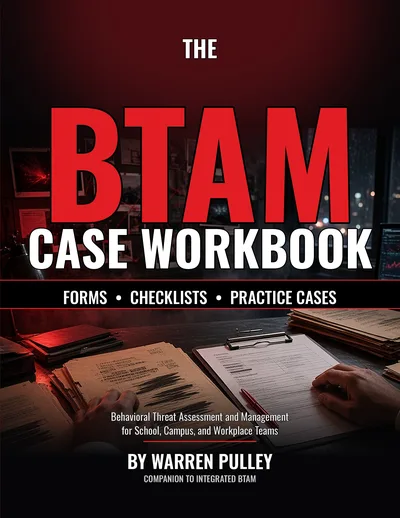
Most threat cases start with one worried person. The BTAM Case Workbook makes a simple point about that moment: how the first conversation goes decides whether the next person bothers to report. So the workbook gives teams three questions to answer at intake, in order.
What are the three intake questions?
- Is anyone in immediate danger? If yes, call 911 or security now. Everything else waits. The workbook's Imminent Danger Screen (Form 5) exists for this step.
- What exactly happened? Exact words, dates, witnesses, and copies, captured on the Concern Intake form (Form 4).
- Who needs to know today? The team leader, and anyone who must act to keep someone safe.
The workbook adds guidance on how to treat the reporter: thank them, take down their exact words, and tell them what happens next. Do not promise confidentiality you cannot keep. Promise instead that the information will be handled carefully and shared only with those who need it.
How does triage work after intake?
Triage (Form 6) is a short team review, ideally within one school or business day. It sorts the case three ways:
- Close: the concern is fully explained and needs nothing more than, perhaps, a conversation.
- Monitor and support: some concern, no pathway; connect support and check back.
- Full assessment: concerning facts the team must understand before it can act.
The team writes down its rationale every time. If a closed case comes back, the next team will want to know what the first one saw.
Why set the law enforcement threshold in advance?
The workbook asks teams to decide, before the first case, which facts require an immediate call to law enforcement: a weapon, an imminent threat, a crime in progress. Everything else the team handles first, with its law enforcement liaison as a member. Writing that threshold down means no one has to decide it under pressure.
Making a threat versus posing a threat
Behind the triage step is one of the most useful distinctions in the field, drawn from Secret Service research: some people who make threats never pose one, and some people who pose a threat never make a direct threat to the target. The workbook's example is a student who writes violent lyrics and may be working through anger in a healthy way, compared with an employee who says nothing to a manager but has told two coworkers about a plan.
What else is in the workbook?
It has 22 write-in forms, from concern intake and the imminent danger screen to interview guides, a pathway-to-violence map, a case management plan, a monitoring log, and case closure. It also has 10 fictional practice cases with discussion questions and debrief keys, and a four-session facilitator guide for team training and tabletop exercises. You can try three of the forms first with the free BTAM sampler.
For the framework behind the forms, see its companion, Integrated BTAM. For a step-by-step overview, read What Are the Steps in a School Threat Assessment?
Get The BTAM Case Workbook
Paperback on Amazon Kindle on Amazon See the book page
As an Amazon Associate I earn from qualifying purchases.
Working on a threat concern now? Get the free Threat Assessment First-Response Checklist.