Insights / Travel Security
Travel Risk Management for Small Teams: The Missed Check-In Ladder
By Warren Pulley ·
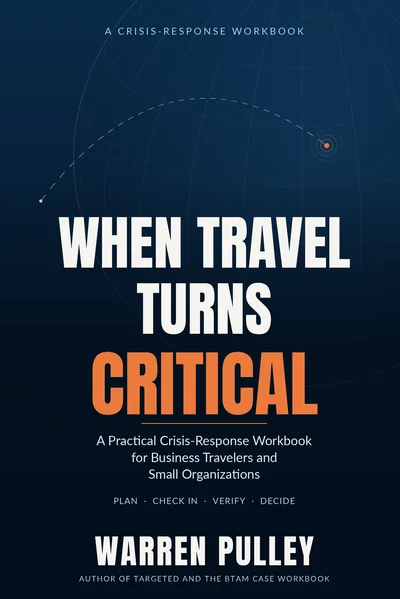
A missed check-in is the most common moment of uncertainty in travel safety, and When Travel Turns Critical argues it is the one small organizations handle worst. Some people call the embassy because a traveler is twenty minutes late. Others wait two days because they don’t want to overreact. Both mistakes have the same cause: no one agreed in advance what a missed check-in means and what happens next.
Who has to be named before a trip?
Large companies have a security operations center. Most small companies, nonprofits, universities, churches, and solo consultants don’t. The workbook replaces it with named people:
- The traveler, who prepares, keeps the check-in schedule, and follows the agreed decision rules.
- The home-office contact, who receives check-ins, starts the escalation ladder, verifies alarming messages, and talks to the family. Every contact has a named alternate.
- The decision authority, one named person with a named backup, not "management," who can cancel a trip, order a traveler to shelter or leave, and approve unplanned spending.
What is a missed check-in escalation ladder?
It is a short, numbered list of actions with time limits, written before the trip. The home-office contact climbs it one rung at a time until the traveler is reached or the matter is in the hands of qualified assistance. The book’s starting point for an elevated-risk trip, measured from the scheduled check-in time, is:
- Grace period, 0 to 30 minutes. Watch the primary and backup channels. People are late.
- Direct contact, at 30 minutes. A standard message, one call, the backup channel. Log each attempt.
- Known associates, at 45 to 60 minutes. The hotel, the host, a colleague, or the driver, using numbers from the trip forms, not from internet searches.
- Decision authority informed, at 60 to 90 minutes. Brief them and agree next steps.
- Qualified assistance, at 90 minutes to 3 hours, or sooner with cause. The assistance provider or insurer, and for U.S. citizens, the embassy or Overseas Citizens Services.
- Local authorities, as advised.
- Family notification, at a point the policy defines in advance.
- Sustained response, handled as a missing-person case.
Two rules sit above the ladder. A duress signal or a credible report of harm skips straight to the notification rungs. And climbing the ladder is never criticized. If the traveler turns up safe after a few calls, that is a success.
Why do code words and callbacks matter now?
Because the alarming message itself may be fake. On December 5, 2025, the FBI warned that criminals were altering photos from social media to use as fake "proof of life" in virtual kidnapping scams, sometimes sending them with timed-message features so victims can’t study them. The workbook builds three defenses that don’t depend on spotting a fake: a pause, with no payment during the first call; a code word agreed in advance; and an independent callback through a channel you already had before the message arrived. The same habits defend a business against cloned voices and impersonation, the pattern described in AI Deepfake CEO Impersonation: Lessons From a $129M Case.
What should a small organization do first?
The book’s advice: use the forms. A completed form is worth more than a well-read chapter. If you have only one evening, fill in the core forms, including the traveler profile, contact card, code word, and the missed-check-in ladder (Form 10), and give printed copies to the home-office contact and the alternate. A one-page ladder in a manager’s desk drawer helps more at two in the morning than a binder no one has read.
Who is the workbook for?
Operations and HR managers, trip leaders, executive assistants, and business travelers whose employer has no travel-security function. It includes 20 numbered fill-in forms, a shelter-or-relocate worksheet, plain-English basics for medical emergencies, lost passports, arrest and detention, and stranding, and nine clearly labeled fictional scenarios with a tabletop exercise guide. It is not legal or medical advice, and it is not a tactical evacuation, ransom negotiation, or cyber forensics manual. For protection of senior leaders, see also Executive Security Spending Moves Beyond the CEO.
Get When Travel Turns Critical
Paperback on Amazon Kindle on Amazon See the book page
As an Amazon Associate I earn from qualifying purchases.
Planning a trip for your team? Pair the workbook with the free Threat Assessment First-Response Checklist for concerns at home.